How We Built It
The engineering behind turning an iPhone camera into a measurement instrument.
The iPhone as a Measurement Instrument
Your iPhone camera captures 240 frames per second. At that speed, a golf ball in flight leaves a motion blur streak across the sensor, a smear of light that encodes how fast the ball is moving.
Most camera systems try to eliminate motion blur. We read it. Motion blur is our signal, not our noise.
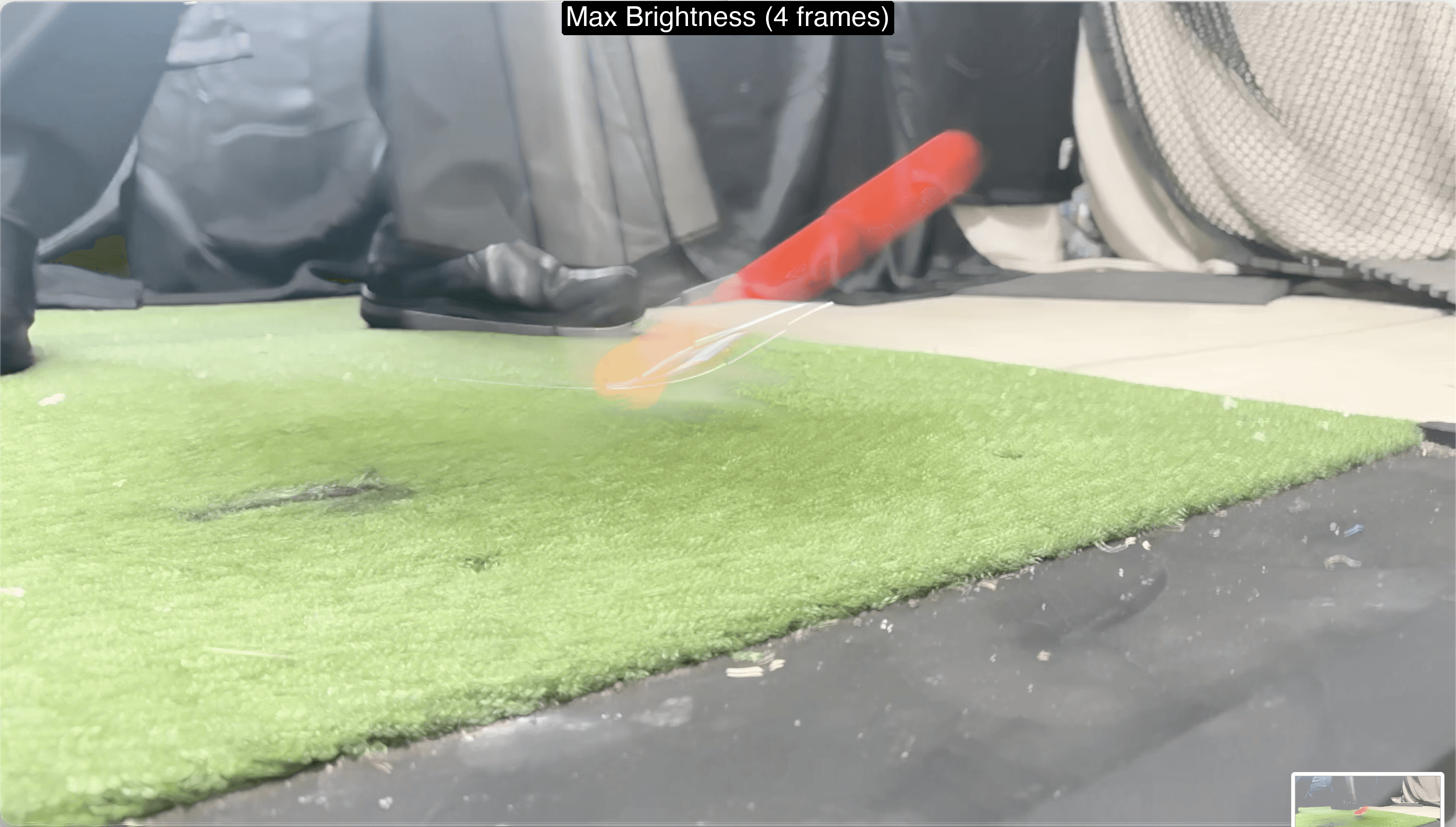
Five frames. One trajectory. Captured at 240fps on iPhone.
Why Colored Balls?
Video cameras capture in YCbCr, a format that separates brightness from color. The Cr channel measures red-orange saturation. An orange golf ball lights up the Cr channel like a beacon. It sits roughly 100 points away from turf on the Cr scale. The club head, the mat, your shoes, the net: none of them are orange. The ball is the only high-Cr object in the scene. The same color science suggests matte red and pink balls should work too, and we plan to validate those next.
White balls sit in the same Cr range as the club face and background reflections. There's no clean separation. We tested it thoroughly. The answer is no.
We could have shipped white ball support with lower accuracy. We didn't.
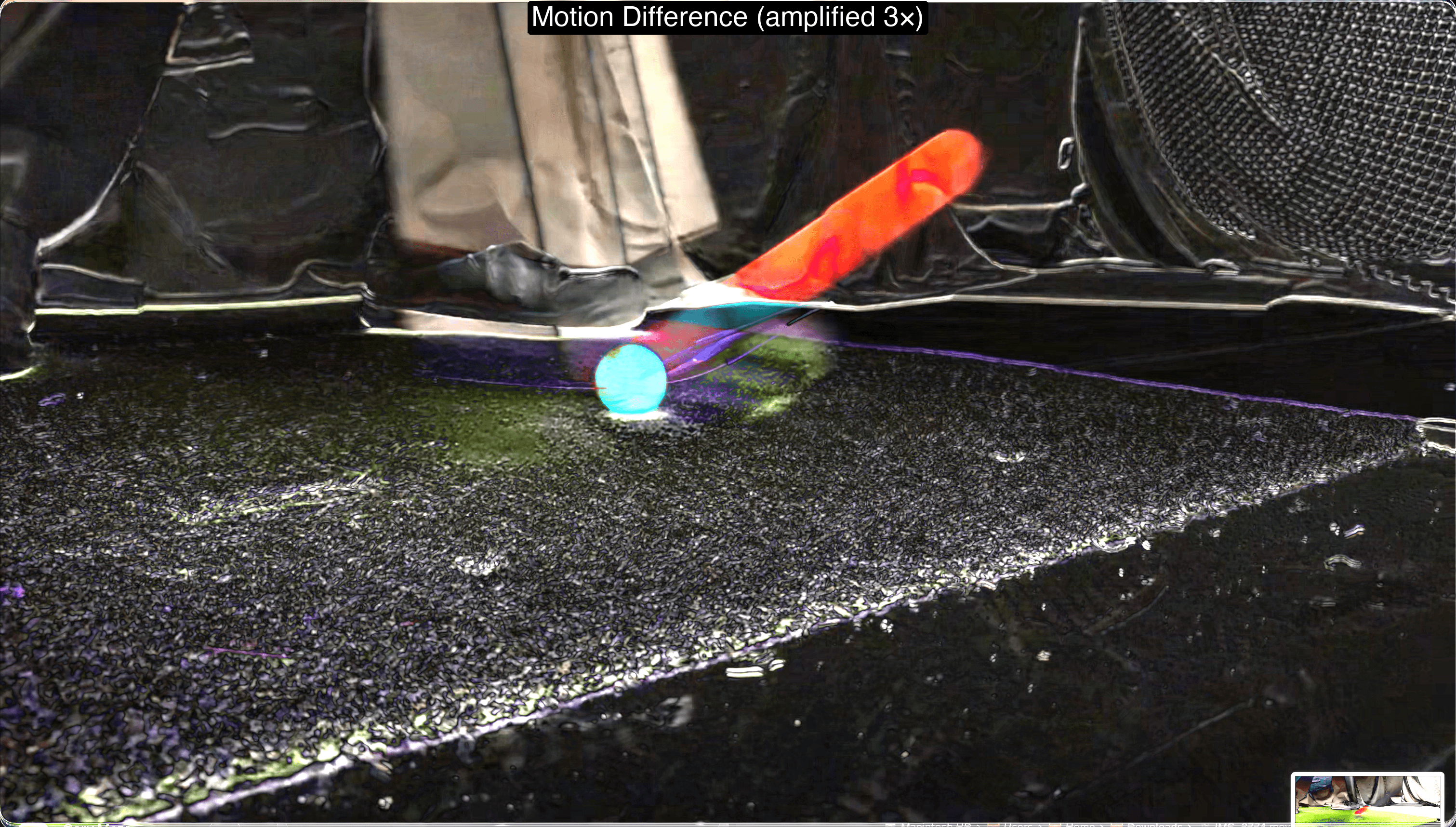
Motion difference, amplified 3×. The ball is the only high-saturation object in the frame.
What We Measure
Two things, measured directly from the camera:
Ball speed
DirectMotion blur streak length
At 240fps, a golf ball in flight smears across the sensor. The length of that smear, divided by the ball’s known diameter (42.67mm), gives speed directly. Faster ball, longer streak.
Launch angle
DirectVertical displacement between frames
The ball’s vertical position changes from frame to frame. The angle of that displacement gives launch angle — how steeply the ball left the ground.
Calculated from physics
- Carry distance — modeled from measured speed and angle using published aerodynamic research (Bearman & Harvey drag model, Palmer lift coefficients)
- Apex height (estimated) — from the flight trajectory derived from speed and launch angle
- Descent angle — modeled from the same ballistic trajectory
What We Don't Measure
Spin
Spin measurement requires imaging the ball's surface, either with patterned markings or high-speed cameras at impact. Systems like the Foresight GCQuad do this with remarkable precision, photographing the ball's rotation at the moment of launch. It's genuinely impressive engineering, and it's why those systems cost $15,000 and up. We took a different path: measure what the iPhone camera can see directly (speed and angle) and be honest about where our measurement stops.
Left/right direction
Acuvis doesn't claim to measure shot direction. From a single phone camera at this distance, left/right direction is below what we can measure honestly — so rather than show you a number we don't trust, we don't show it. We'd rather be the device that's honest about what it measures than one that fakes a figure.
Driver (V1)
The tee elevates the ball and changes the camera geometry. We're building driver support. It's a geometry calibration problem, not a physics problem. But we won't ship it until it's accurate.
This is what “no measurement is better than a wrong measurement” looks like in practice.
Validated Against Professional Systems
Acuvis is currently being validated against a Foresight Falcon, a professional-grade photometric launch monitor trusted by PGA Tour club fitters and used in facilities worldwide. We will publish the full accuracy comparison here once testing is complete.
We only publish what we can verify.
Read the full story
How a golfer in Eugene built a launch monitor from scratch. The failures, the pivot, and the garage.
Our Story